
Diwali Far From Family: Festival Loneliness and Homesickness
By Ashti Mistry, LICSW, Founder & Clinical Director, Bee Insightful Therapy
Diwali in 2026 falls on Sunday, November 8. If you’re feeling lonely, homesick or sad because family is far away, that’s a common and very human response, especially when you’re raising kids without the people and noise you grew up with. Below, I share why festival loneliness can feel so loud and gentle ways to cope, build community and create traditions of your own.
Festival season is here. For many South Asian families, that means lights, sweets, new clothes, prayers and the people we love most. It can also mean an ache that is hard to put into words, especially when you’re raising young children in Massachusetts or Rhode Island and the people who made those festivals feel like home are far away.
If you feel both joy and sadness this time of year, nothing is wrong with you. Both can be true at the same time.
What I Hear From Clients During Festival Season
Many of my clients are excited when festival time arrives. In our sessions, we talk a lot about what festivals were like for them growing up: the traditions their parents and families kept, their favorite foods, who was in charge of which part of the celebration, and whether there were fireworks. Many clients’ faces light up as they share these memories. There are so many smiles.
Alongside those memories, there are often real questions about the present.
For clients who are immigrants and whose parents are back in India, the questions often sound like this:
- Do we take the children to the temple?
- What food do we make, and will it taste the same?
- Should we host a party or go to one?
- How do we explain it to the kids if they see Mama or Dada a little sad because their own parents aren’t here to celebrate?
For clients who grew up here in America but live in a different state than their parents, the questions are a little different:
- Do we go “home” to celebrate?
- Do we take the kids out of school and travel?
- Is it worth it, for the memories and for the amount of money it takes to travel?
There is no single right answer to any of these. But they’re worth talking about, because they carry a lot of feeling.
Why Festivals Can Make Loneliness Feel Louder
Festivals are made of memories, and so many of those memories include people. When some of those people are missing, the festival can make their absence easier to notice.
Missing the noise and crowd of home
For many of us, festivals growing up meant a full house: relatives, neighbors, food cooking all day, everyone with a role. A quieter celebration here can feel very different, even when it’s still meaningful. It’s also possible to feel lonely while surrounded by people, at a party or a temple, if the people you’re missing aren’t there.
Pressure to make it magical for your kids
Many parents want their children to feel the same excitement they felt as kids. That can turn into pressure to recreate everything: the right food, the right rituals, the right feeling. When you’re doing it without the extended family who used to share the work, it’s easy to feel stretched thin, or to feel you’re falling short.
Grief for parents and relatives far away or no longer here
Festival season can bring up grief, whether you’re missing parents across the world, a few states away, or relatives who have passed. It can also bring up guilt toward parents back home who are celebrating without you and their grandchildren. These feelings often show up most strongly on days that are supposed to be happy.
One Festival Season, Many Ways to Celebrate
When I work with clients, I find it important to remember that “festival season” means just that. It isn’t one festival for every religion in India. I ask which festival is important to them and their family.
For interfaith families, I ask how the festival season is experienced in their home. It’s also important to remember that different parts of India celebrate the same festival in different ways. Diwali is celebrated by Hindus, Sikhs, Jains and some Buddhists, each with their own meaning and traditions, and many South Asians don’t celebrate it at all. Your family’s way is valid.
Creating Your Own Family Traditions
As a South Asian mother, I’ve learned that traditions don’t have to look exactly like they did when we were growing up to mean something.
My father is Zoroastrian/Parsi, and I grew up eating Rava, a sweet dessert, on Navroze (Parsi New Year). Each year my mother made it for our family, and when I was old enough, I began helping her. Now I have my own children help me make Rava for Navroze.
For me, it’s a way to teach my kids about my religion and make memories with them. I also get to reflect on doing the same thing with my own mother when I was growing up. The smells and sights of making Rava take me back to my childhood kitchen with her.
Your tradition might be a dish, a prayer, a song, a story, or a phone or video call with grandparents at the same time each year. It doesn’t need to be big. What matters is that it’s yours.
If you’re not sure which traditions matter most to keep, the values bullseye exercise can help you sort out what feels most important to your family right now.
Building Community With Young Kids in MA and RI
Finding community as a parent can take time, especially when your children are young and your days are full. A few gentle places to start:
- Your child’s school or daycare. If your child is in school or daycare, offer to go in and teach the children about your festival. Bring coloring sheets or an activity they can do while you talk about the festival your family celebrates. Your child may be one of only a few children at school who celebrate it, and this is a lovely way to help them feel seen by their peers. It’s also a wonderful way to teach children about the cultures of the world.
- Libraries and community centers. Some host cultural events or story times during festival season.
- Other parents. The parent you chat with at pickup may be looking for community too.
A few local places to start
Temples, gurdwaras and cultural associations across Massachusetts and Rhode Island welcome families during festival season and all year. Here are a few, from different traditions and regions:
- Sri Lakshmi Temple (Ashland, MA): A Hindu temple in MetroWest Boston that posts monthly calendars of poojas and festival celebrations.
- Westborough Gurdwara Sahib, New England Sikh Study Circle (Westborough, MA): A Sikh gurdwara open daily to everyone, with weekly diwans and classes for youth and adults.
- Jain Center of Greater Boston (Norwood, MA): A Jain center serving families across New England, including Rhode Island, with pathshala classes, youth programs and an annual Diwali celebration.
- Rhode Island Hindu Temple Society (Warwick, RI): A Hindu temple with weekly poojas and festival programs, listed on its online calendar.
- India Association of Rhode Island (Providence area, RI): A cultural nonprofit serving Greater Rhode Island that hosts community events, including a yearly Diwali Fest.
Bee Insightful Therapy isn’t affiliated with these groups; check their sites for current events.
When the Loneliness Doesn’t Lift After the Festival
Honestly, seasonal loneliness is worth bringing to therapy at any time. If you’re feeling lonely, even while you’re around people, or if you’re missing people, you can come to therapy. A culturally attuned therapist will hear you out.
It may be especially worth reaching out if the sadness stays with you after the festival ends or starts to affect your sleep, your energy or how you feel day to day. You can learn more about our depression therapy and our mental health support for immigrants. If you’re also adjusting to a new baby, our South Asian postpartum therapy page may help. If this season of life feels like a big shift, read more about therapy for life transitions.
The holidays can be hard for many people. You are not alone.
Online Therapy for South Asian Parents in MA and RI
At Bee Insightful Therapy, we offer online therapy for adults located in Massachusetts and Rhode Island. As a South Asian woman and a mother, I understand how much meaning, and how many mixed feelings, festival season can hold.
Therapy can be a space to:
- Talk about the memories and traditions that matter to you
- Sort through guilt, grief or homesickness without having to over-explain your culture
- Think through practical decisions, like whether to travel “home” or celebrate here
- Find ways to cope with loneliness that fit your family
We’re in network with Aetna, Blue Cross Blue Shield of Massachusetts, Cigna, Harvard Pilgrim, Optum and UnitedHealthcare for sessions in Massachusetts; Rhode Island sessions are private pay, and we can provide a superbill for possible out-of-network reimbursement. See costs and insurance. Every new client starts with a free 15-minute consultation.
Sessions are in English. If you’d be more comfortable in another language, please ask during your free consultation and I’ll help you find the right fit.
Common Questions
Why do I feel so lonely during Diwali when I’m away from family?
Festivals are full of memories, and most of those memories include the people we love. When those people are far away, their absence can feel louder on the days that are meant to be shared. It’s possible to feel lonely even when you’re surrounded by people. That is a very human response, not a sign that something is wrong with you.
How do I make Diwali feel special for my kids without family around?
It doesn’t have to look exactly like your own childhood. Choose one or two traditions that matter to you, such as a dish, a prayer, a story or a call with grandparents, and invite your children to help. Cooking together is one way to pass on your culture and make new memories at the same time.
How can I find a South Asian community near me in Massachusetts or Rhode Island with young kids?
Start where your family already is. If your child is in school or daycare, offer to teach the class about your festival with a simple activity. Temples, gurdwaras, Jain centers and cultural associations, such as the Sri Lakshmi Temple in Ashland, the Westborough Gurdwara, the Jain Center of Greater Boston, the Rhode Island Hindu Temple Society and the India Association of Rhode Island, can also be good places to connect. Libraries and other parents are good places to start too.
Is it normal to feel sad or homesick during festivals years after moving?
Yes. Homesickness and grief can show up during festivals whether you moved recently, moved decades ago, or grew up here and live in a different state from your parents. Festivals tend to bring up memories of home, so it makes sense that the feelings return each year.
When is holiday loneliness something to talk to a therapist about?
Any time. You don’t need to wait until things feel unbearable. If you’re feeling lonely, even while you’re around people, or you’re missing people, a culturally attuned therapist can hear you out. It may be especially worth reaching out if the sadness lingers after the festival or affects your daily life.
How can I cope with homesickness as an immigrant during the holidays?
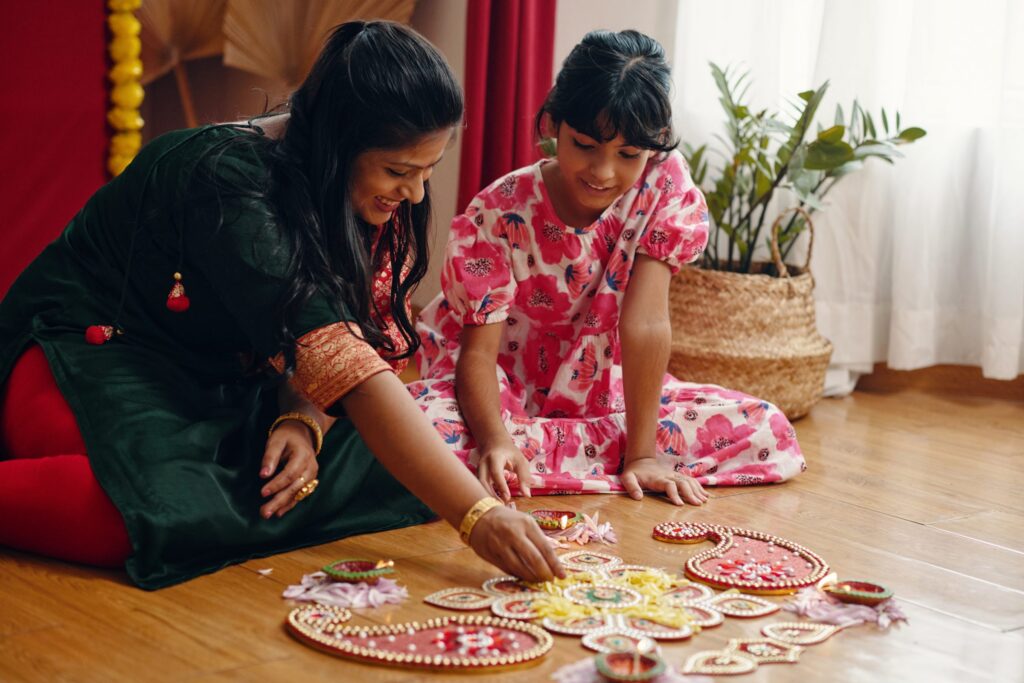
Start by naming it. Missing home at festival time is a normal response to distance, not a sign you made the wrong choice. Small rituals can help, like a video call during puja, cooking a dish from home, or lighting diyas with your kids. If the homesickness lasts for weeks or starts affecting your sleep, work or parenting, talking with a therapist can help.
Is it normal to feel happy and sad at the same time during Diwali?
Yes. Many people feel joy in the lights and celebrations alongside grief for the people and places they miss. Both feelings can be true at once, and you don’t have to push the sadness away to enjoy the day.
If the Festival Season Feels Heavy This Year
If the festival season feels heavy this year, a free 15-minute consultation is a gentle first step. Online therapy is available anywhere in Massachusetts and Rhode Island.
Book your free consultation or call (617) 603-0630.
If you’re in crisis or thinking about harming yourself, call or text 988 (Suicide & Crisis Lifeline) or call 911.